
In the world of workers’ compensation, staying current on best practices is key — and that’s where Continuing Education Units (CEUs) come in. CEUs are accredited learning opportunities that help professionals maintain their licenses, deepen their expertise, and stay up to date on evolving industry standards. For workers' comp adjusters, CEU courses are a valuable way to build skills, expand knowledge, and gain insights into new tools and strategies shaping claims management — like the growing role of objective data in musculoskeletal (MSK) recovery.
FIGUR8 team member Jeff Vari, PT, DPT, MBA, has created a profound look into the evolution of biomechanical data and AI-driven insights in his CEU course “Using Objective Data to Guide MSK Recovery” that supports claims adjusters. The CEU course focuses specifically on how novel technology is transforming and simplifying MSK claims management - allowing for better outcomes for injured workers and ultimately leading to faster claims resolution.
Below you will find a brief outline of the content that is covered in the CEU courses that take place periodically throughout the United States.
As objective data begins to pave the way in MSK treatments, it’s imperative to understand what objective data is and its application to MSK recovery, the importance of current technologies that support the use of objective data in claims management, and its benefit to adjusters.
Using Objective Data to Guide MSK Recovery
Many adjusters would agree that musculoskeletal (MSK) injuries tend to be one of the more challenging case types while handling workers’ compensation claims. MSK injuries are complex, often challenging to heal, and have diverse outcomes based on a large variety of factors. Due to this variety, recovery for one injured worker can look very different from recovery for another. Adjusters are often challenged day-in and day-out to accurately evaluate progress and make correct verdicts on paramount decisions during recovery, including a claimant's compensability and whether or not medical necessity is evident.
As technology and healthcare continue to integrate, partners like FIGUR8 are raising the standard of care in MSK health and increasing clarity with the support of objective insights into individual recovery.
1. What is Objective Data and How does it Support Injury Recovery?
Objective data refers to measurable, quantifiable information that provides insight into a person’s physical state and functional capabilities. Subjective data, such as asking a patient to rate their pain on a scale of one to ten, can be beneficial, but is subjective and does not provide reliable information on physical health. When making important decisions in claims management, having objective data allows adjusters to utilize consistent, reliable, and reproducible data which allows for greater accuracy in claim decisions while lightening the load of sifting through case updates.
Types of Objective Data in MSK Recovery
In the context of musculoskeletal care, objective data can include:
- Joint Range of Motion (ROM): How far a joint can move in different directions.
- Muscle Activation: Measured through technologies like surface mechanomyography (sMMG).
- Functional Performance: How well a patient performs functional movement patterns such as walking, bending, or squatting.
- Positional Endurance: Measured using precise sensors that allow better understanding in tolerance related to functional and work related tasks.
- Movement Quality: The ability to look at more than just quantity of motion and gain greater insight into function and sustainability of a particular movement / task.
Being able to access objective data removes guesswork and helps guide decision making. Instead of over relying on subjective patient feedback, adjusters and clinicians can now visualize recovery progress with precision.
2. Why Use Objective Data in Workers’ Compensation Claims?
For workers’ compensation claims adjusters, objective data provides several strategic advantages:
- Improved Decision-Making
One of the biggest challenges in MSK claims management is determining whether a
worker is genuinely progressing or has plateaued in their recovery. Objective data allows
adjusters to:
a. Track functional improvements over time with consistent metrics.
b. Compare current function against baseline data and health reference ranges.
c. Validate whether a treatment plan is effective or if adjustments are needed.
For example, joint range of motion and muscle strength measurements can
reveal whether an injured worker’s physical capacity aligns with their job
requirements. - Improved Claim Communication
Subjective data often leads to misalignment between adjusters, providers, and injured
workers. Objective data reduces disputes by providing clear, measurable evidence of
recovery progress, whether it be positive or negative.
a. If a worker reports ongoing pain but objective data shows improved joint function
and muscle strength, an adjuster can objectively evaluate whether additional
and/or alternative treatment is necessary.
b. If the data indicates poor recovery despite consistent therapy, it may prompt a
reassessment of the treatment plan or consideration of alternative care options.
c. This helps prevent unnecessary treatments, overutilization of care, and
protracted claims. - Faster Claims Resolution
Accurate data leads to more informed and timely decisions. When adjusters have clear
evidence of functional recovery, they can:
a. Confirm treatment is medically necessary for injured workers.
b. Close claims more quickly when recovery is complete.
c. Justify medical necessity with precise clinical data.
d. Reduce time spent reviewing notes that provide subjective data and limited value.
e. Understand an injured worker's objective status as it relates to their injury and work related recovery - Better Outcomes for Injured Workers
Objective data enhances not only claims insight but also patient outcomes. When
treatment plans are guided by objective data on joint function and muscle performance,
care becomes more effective through individualization.
a. Providers can modify rehab protocols based on response to care.
b. Workers feel more confident in their recovery when they see measurable improvements.
c. Early identification of recovery setbacks allows for faster clinical intervention.
By using data to align clinical goals with functional recovery, adjusters and providers can ensure more successful return-to-work outcomes, leaving all involved parties happy and healthier.
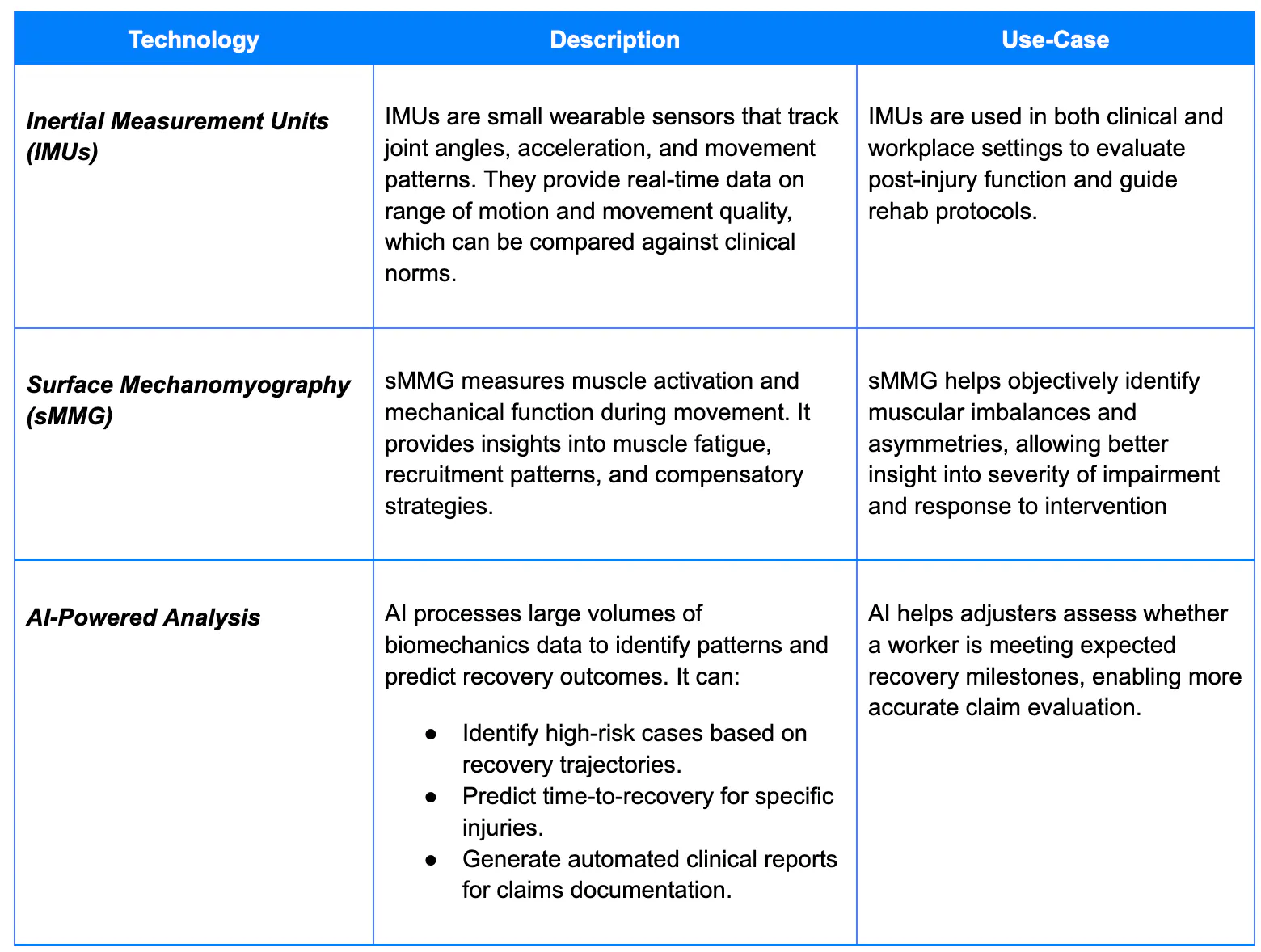
3. What Exists Today?
The use of objective data in MSK claims management has expanded significantly with the rise
of AI and advanced biomechanics tools. Several leading technologies are shaping the
landscape.
How Adjusters Can Leverage Objective Data
Integrating objective data into the claims process doesn’t require a complete overhaul of
existing systems.
Adjusters can start by:
1. Partnering with clinics and providers who use objective tools.
2. Requesting functional progress reports that include objective metrics.
3. Using AI-generated data to identify intervention progress and triage appropriately.
By aligning clinical insights with claims decisions, adjusters can resolve cases faster, reduce costs, and improve worker satisfaction
The Future is Bright
Objective data is transforming MSK recovery and claims management. By replacing subjective assessments with measurable insights on joint motion, muscle strength, and functional endurance, adjusters can make better decisions, reduce disputes, and accelerate return-to-work outcomes.
AI and objective tools provide the framework for a more precise, data-driven approach to MSK care—allowing claims adjusters to work smarter, not harder. The future of workers’ compensation lies in using data to bring clarity and confidence to every claim.
How FIGUR8 is Leading the Way
FIGUR8 is at the forefront of this shift toward data-driven MSK care.
The FIGUR8 bioMotion Assessment Platform (bMAP) captures high-quality biomechanics data using advanced sensors and AI. This provides clinicians and adjusters with detailed insights into joint motion, muscle function, and recovery progress. By integrating FIGUR8’s objective data into the claims process,adjusters can reduce disputes, accelerate resolution times, and improve return-to-work outcomes. FIGUR8’s technology empowers both clinicians and adjusters to make smarter, more confident decisions.
For more insights on how to integrate objective data into your claims process, reach out to the team at FIGUR8 at info@figur8tech.com
![[object Object]](https://images.prismic.io/figur8tech/65c20091615e73009ec452e8_SurgicalvsNon-SurgicalProcedures%E2%80%93The%E2%80%9CGreatDebate%E2%80%9Dof2022.jpg?auto=format,compress)
![[object Object]](https://images.prismic.io/figur8tech/aC3v6idWJ-7kSZ5Q_LowBackPain-1--min.png?auto=format,compress)
![[object Object]](https://images.prismic.io/figur8tech/aHD8zUMqNJQqHyv3_1.png?auto=format,compress)
![[object Object]](https://images.prismic.io/figur8tech/aIOKElGsbswqTQU-_202507FIGUR8RecoveryIndicator-1-.png?auto=format,compress)
![[object Object]](https://images.prismic.io/figur8tech/aFVdBHfc4bHWikqi_%5B2025May%5DBlogCoverTemplates-BiomarkersBlog.png?auto=format,compress)
![[object Object]](https://images.prismic.io/figur8tech/ZxAERIF3NbkBXljh_FIGUR8BlogonAPTAPPSMeeting2024HeaderImage-1-.jpg?auto=format,compress)
![[object Object]](https://images.prismic.io/figur8tech/Zym3ja8jQArT0Lxo_FIGUR8CreatingaCommonLanguageinMusculoskeletalCareBLOG.jpg?auto=format,compress)
![[object Object]](https://images.prismic.io/figur8tech/Z1tik5bqstJ98cbE_NanWeiGongFIGUR8HeadshotOutdoor-1-.jpg?auto=format,compress)
![[object Object]](https://images.prismic.io/figur8tech/Z0DZ8K8jQArT1ON0_BackinMotionPhysicalTherapyFIGUR8.jpg?auto=format,compress)
![[object Object]](https://images.prismic.io/figur8tech/ZrYfc0aF0TcGI0w7_unnamed.jpg?auto=format,compress)
![[object Object]](https://images.prismic.io/figur8tech/Z_gXN-vxEdbNO3zJ_ChrisBrighamBlog.png?auto=format,compress)