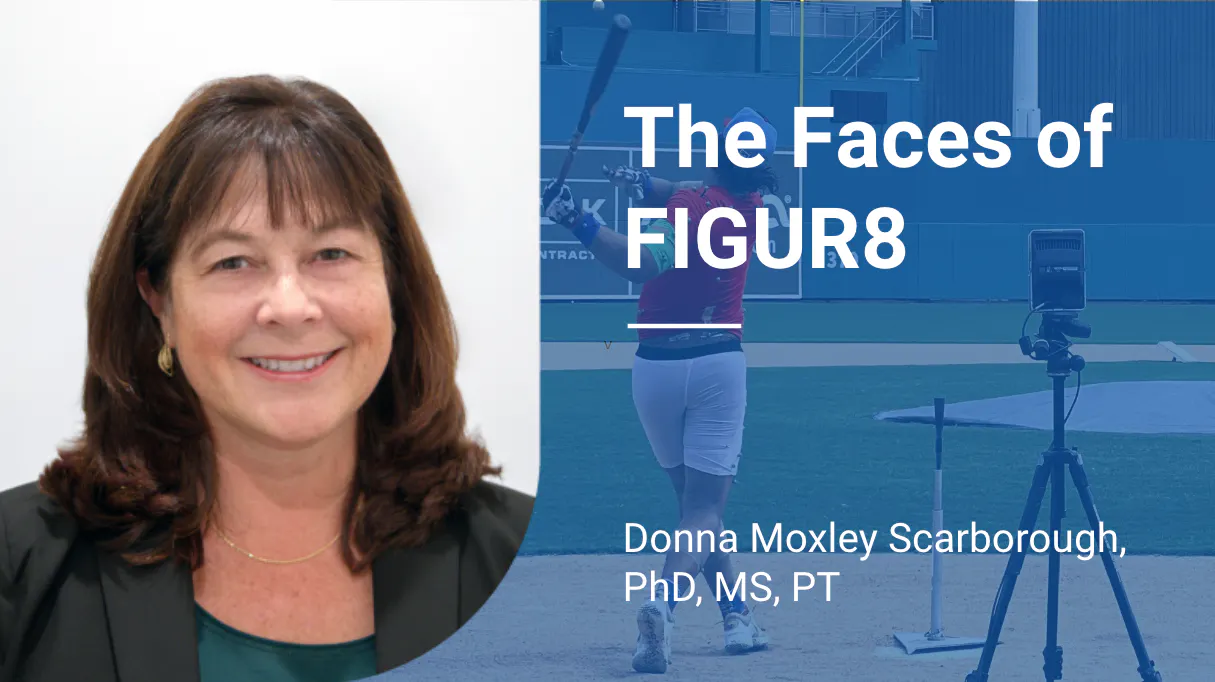
At FIGUR8, our vision is shaped by the brilliant minds of our team.
In our "Faces of FIGUR8" series, we sit down with these industry leaders to uncover the personal motivations, technological innovations, strategic approaches, and future visions that guide their work and fuel their excitement about FIGUR8. Through eight carefully crafted questions, we'll delve into what drives each leader’s passion for transforming musculoskeletal care, how they envision the future of health tech, and the innovative strategies they employ to lead us toward more profound care.
Rewriting the Rules of Recovery: A Clinician-Turned-Innovator’s Vision for the Future of MSK Health
Donna Moxley Scarborough, PhD, MS, PT, is a leading expert in biomechanics and musculoskeletal health. Her work continues to focus on integrating biomechanics to optimize human performance & recovery while reducing vulnerability to injury. She co-developed the FIGUR8 biomechanics platform and pioneered the use of surface mechanomyography (sMMG) measurements. With extensive experience in sports medicine rehabilitation, clinical & biomechanics research, technology development and clinical applications, Dr. Scarborough plays a key role in advancing FIGUR8’s clinical innovation.
1. Personal Journey and Connection
Q: Can you share a bit about your personal journey and how you joined FIGUR8?
A: I'm a physical therapist by training, and from early on, I’ve been deeply interested in understanding how to help people move better. I focused heavily on orthopedics and neurology, taking particular interest in the study of motor control and the musculoskeletal system.
While working in the clinic, I pursued a master’s degree in a program that included an internship at The Massachusetts General Hospital (MGH) Biomotion Lab which was one of the first biomechanics labs in the USA to analyze human joint motion and forces during gait and other activities of daily life. My master’s degree research was studying the relationship of strength on movement patterns of aging adults during rising from a seated position and other common activities. That experience was transformative—it gave me access to creative engineers at MIT and clinical researchers at MGH, who in turn sparked new ways for me to think about biomechanics and how to help people move better.
Back then, for clinicians, our evaluation tools were traditionally limited to what we could assess with our hands and eyes. But studying biomechanics and the technology used opened a world of objective measurement and real-time feedback to me; unfortunately, it was largely confined to research lab settings.
Meeting Dr. Nan-Wei Gong, FIGUR8’s CEO, was another turning point. At the time, I believe it was in 2016, I was working on my PhD and also was the Clinical & Research Director of the Massachusetts General Hospital Orthopaedics Sports Performance Center. The Center was forward thinking and a key focus was integrating biomechanics into sport performance, return to sport after injury and injury avoidance programs for athletes. The Center’s Director, Eric Berkson, MD, and I were exploring mobile biomechanics technology, to help evaluate outside the walls of the lab and bring biomechanics data into clinicians hands. I saw the potential in the sensor that Dr. Gong introduced to us that day as an avenue to create a new type of wearable biomechanics sensor. Nan-Wei and I discussed how the sensor had the capabilities to capture novel mechanical information about muscle contraction. Collaborative studies were initiated to develop this sensor and with her leadership, in a few years, it became what is now known as Surface Mechanomyography (sMMG).
Together, with a team of amazing engineers and staff, the FIGUR8 biomechanics platform which includes the sMMG and other sensors was launched within a couple years.
After working at FIGUR8 for about 4 years, I was offered a position to work with the Boston Red Sox to lead up their first Biomechanics Department. This was an amazing opportunity to merge my passion of studying human movement patterns, help athletes perform better and recover better with my love of baseball. The experience was invaluable in preparing me for my return back to FIGUR8 and continuing research in human movement.
I am fortunate to have experiences working with patients ranging across many pathologies and ages as well as with elite athletes seeking peak human performance levels. This exposure gives a full-spectrum view on how biomechanics movement data can be applied. I love the challenge of taking the complexity of human movement, teasing it apart to reveal key components that a person can modify to reach their best movement performance potential.
Having returned to FIGUR8, I’m elated to see how far the biomechanics platform has come and its impact on patient care in physical therapy clinics. I look forward to developing more clinical solutions through the integration of biomechanics. This has been a goal of mine for many years.
2. Vision and Mission Alignment
Q: How does FIGUR8’s mission to revolutionize musculoskeletal care resonate with your own professional values and goals?
A: Clinicians today are being asked to measure change more accurately, to align treatment with patient goals, and to document it all. Those goals aren't always about specific joint angles or muscle strength but rather, about real life: going back to work, caring for family, exercising pain-free.
When someone’s movement is disrupted, they turn to us as clinicians for help. If we can’t measure and understand that movement clearly, we’re at a disadvantage. Biomechanics provides individualized movement data. FIGUR8 gives us the tools to objectively track movement and outcomes so we can treat more effectively and efficiently.
What I love is that FIGUR8 pushes both clinicians and the company to keep asking the right questions: How can we better understand movement? How can we treat patients more effectively? That’s been at the heart of my career goals for many years, seeing biomechanics data accessible outside of the lab and its value becoming realized in clinical settings, through the FIGUR8 biomotion platform it is incredibly exciting and rewarding.
3. Technological Innovation
Q: In your opinion, what makes FIGUR8 stand out in the healthcare technology landscape?
A: FIGUR8’s strength is the focus on the patient first and the clinician a close second. So much health tech is thrown at clinicians with little improvements to their day-to-day practice and with some tech, unsure benefit to the patient. From the beginning, FIGUR8 has aimed to serve both. Having biomechanical analyses of a patient enhances care by providing individualized data to improve clinical decision making in a world of treatment practices based on standardized protocols. Patients can also see their data changing over time which typically improves patient involvement in their rehabilitation regime. The FIGUR8 platform is easy for clinicians to use and integrate into their workflow and is a tool that can capture patient regression or progression longitudinally across multiple objective measurements that our eyes may not see or can't measure. It is a tool that supports the clinicians treatment planning. These are the primary reasons that makes FIGUR8 stand out in healthcare technology.
4. Impact on Patient Care
Q: How has FIGUR8’s technology transformed patient outcomes and recovery times?
A: Integrating FIGUR8 into clinical workflows allows us to objectively assess movement and directly use the gathered data documentation and treatment plans. This is critical information for healthcare systems and payers.
The collection of objective data also greatly benefits the patient. As I alluded to earlier, when patients can see their data and track progress, engagement and continuation of treatment increases. It gives clinicians confidence when both initiating and adjusting treatment plans. That ability to pivot quickly based on objective data can accelerate recovery and improve outcomes.
5. Challenges and Solutions
Q: What are some of the biggest challenges FIGUR8 has faced in its development and implementation, and how have these been overcome?
A: Some of the biggest challenges that FIGUR8 has faced in its development & implementation may surprise some people as for the most part they are not related to the technology build out itself. In general, biomechanics based technology has advanced and as an entity it is just waiting, dangling carrots for MSK health care clinicians to grab hold of, particularly those specializing in rehabilitation. Our FIGUR8 engineers and designers are fabulous and have created ways to make our on-body system form fitting, powerful, robust and user friendly.
The primary challenges are ones that all biomechanists experience and that is how to boil down the key actionable points from copious amounts of biomechanical data into directed actionable insights. Over the years, the FIGUR8 team has worked very hard at simplifying the translation into clinical messaging and we now have AI assisting with this in our automated reporting. Our design team is continuingly improving ways to illustrate findings in our reports for clinicians and payors. The FIGUR8 bioMotion Assessment Platform (bMAP) is ahead of many biomechanics platforms in addressing these challenges.
Perhaps the largest challenge is, as with any new technological tool, finding the best way to integrate the platform into the clinicians busy daily workflow. The FIGUR8 team works with a few key physical therapist user groups to get feedback regarding the clinicians needs in order to help improve product design and data output. This is essential to our success. Clinicians' time is limited. The FIGUR8 platform assessments can be completed in as little as 5 to 15 minutes. Some clinics have trained clinical technicians to perform the evaluation to expedite the workflow. The FIGUR8 report summary can be copied and pasted directly into the clinicians progress notes or downloaded as a complete report and shared to referring providers. The data integration with Electronic Health Records (EHR) is another example of solving a FIGUR8 implementation challenge for clinicians. On top of measurement and data integration, the team at FIGUR8 dedicated much attention to help clinicians understand paths for reimbursement.
6. Future of Musculoskeletal Care
Q: Where do you see the future of musculoskeletal (MSK) care heading, and how do you envision FIGUR8’s role in that future?
A: The future of movement analysis is incredibly exciting and constantly evolving. We’re already seeing advancements like computer vision and AI that can analyze how people move using cameras and minimal physical equipment.
I envision a world where capturing and measuring a person’s MSK health is less invasive, more comprehensive and fully integrated in health care, wellness and sport performance. Ultimately, allowing us to blend more tools like FIGUR8’s sMMG to enrich insights on muscular data and other physiologic measurements.
These advances of biomechanics technology for MSK care will extend beyond physical therapy and orthopedic clinics; it will infiltrate wellness centers, physician annual well-visit check ups, pre-surgical assessments, monitoring and informing movement health in our aging adults, even pediatric movement screening for school aged children.
FIGUR8’s approach, built on solid biomechanics and backed by AI, is foundational. It grows with new technical developments while remaining rooted in clinical relevance. That’s the key to long-term impact.
7. Collaborations and Partnerships
Q: How important are research collaborations from a clinical perspective at FIGUR8?
A: They’re absolutely essential. Innovation doesn’t happen in isolation. FIGUR8 thrives with collaboration- whether it be with clinicians, researchers, universities, patients, or health systems.
Clinical feedback leads us on how to improve our product. Academic partnerships bring fresh ideas and research. Collaborations with orthopedic surgeons and other specialties open up new use cases. Working with students brings creativity and new energy to everything we do.
If we want to reshape musculoskeletal care, we need these partnerships. I always encourage students or clinicians with feedback about our platform or if they have a new insight to reach out—we're eager to work with passionate people who want to make a difference.
8. Advice for Innovators
Q: What advice would you give to clinicians looking to make an impact in health tech?
A: Go for it. If you’re passionate about solving a problem—especially in patient care—don’t hesitate to pursue it. If you lack the technical expertise needed, find someone who does. Innovation is a group effort. The best innovations often come from collaboration. Don’t be afraid to ask tough questions: “Would this actually help in your workflow?” Even if the answer is no, you might uncover a new path or application. When one door closes, another opens.
Some of the best projects I’ve worked on started when MIT students asked whether their ideas could be useful in healthcare. We’d brainstorm together, and that process led to some amazing solutions.
Share your ideas, find the right collaborators, and take that next step; a question as simple as, “What do you think?” can provide groundbreaking feedback that sets you on the course to success.
FIGUR8’s team has benefitted exponentially from brilliant, passionate minds such as Donna’s.
FIGUR8 is constantly looking for ways to further improve current and develop new solutions within musculoskeletal care. If you are interested in what’s next or want to get involved, consider reading through FIGUR8’s research endeavors here.
![[object Object]](https://images.prismic.io/figur8tech/Ziu0r93JpQ5PTNEU_FIGUR8-whiplash-output.png?auto=format,compress)
![[object Object]](https://images.prismic.io/figur8tech/aBsfcSdWJ-7kRssc_image8.png?auto=format,compress)